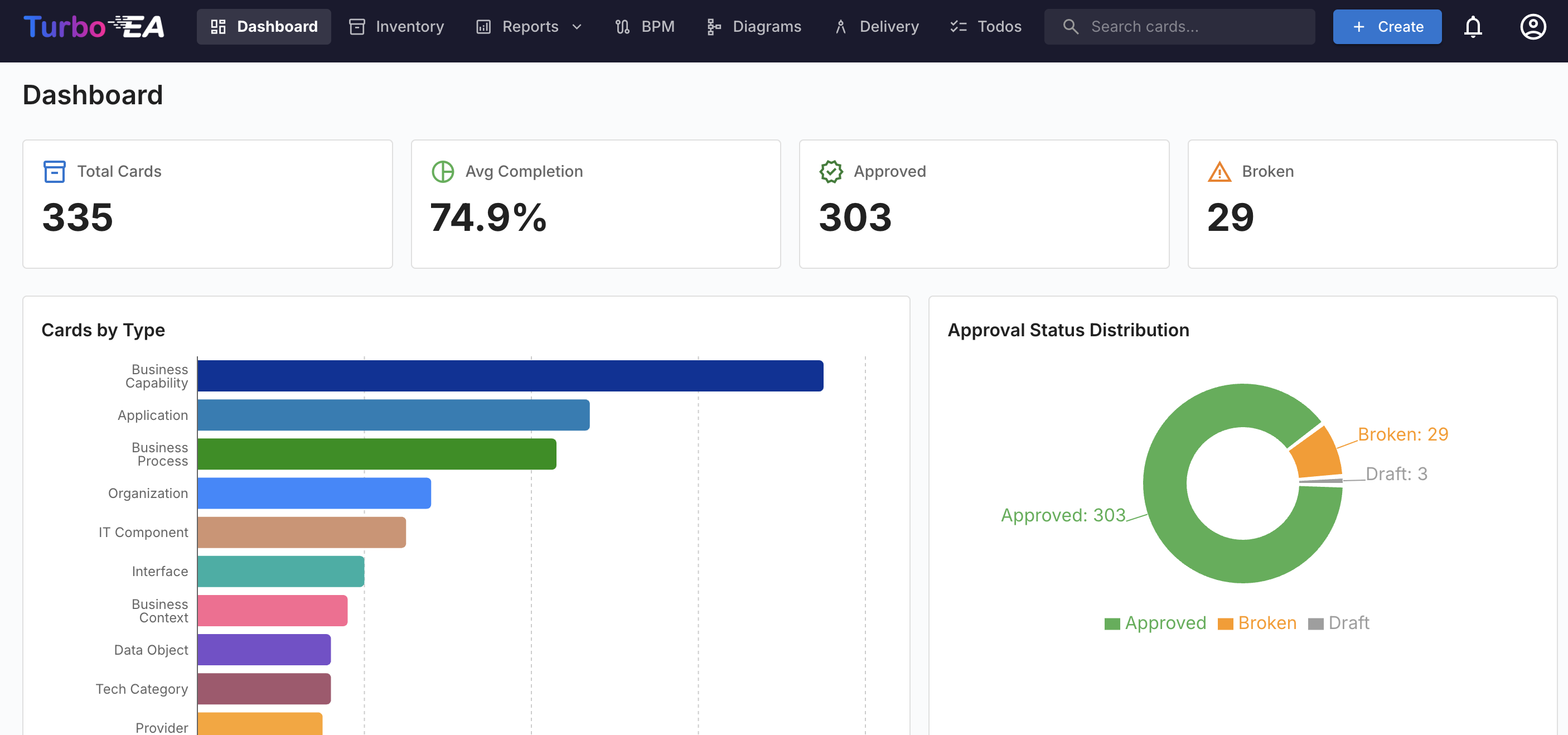
Turbo EA is an Open Source self-hosted Enterprise Architecture Management platform with embedded BPM. Map applications, capabilities, technologies, and their relationships — all with a fully admin-configurable metamodel, AI-assisted metadata, and multilingual support.
From inventory management to architecture delivery, Turbo EA covers the full EA lifecycle.
Define your own card types, fields, subtypes, and relation types. The metamodel is data, not code — adapt it to any EA framework.
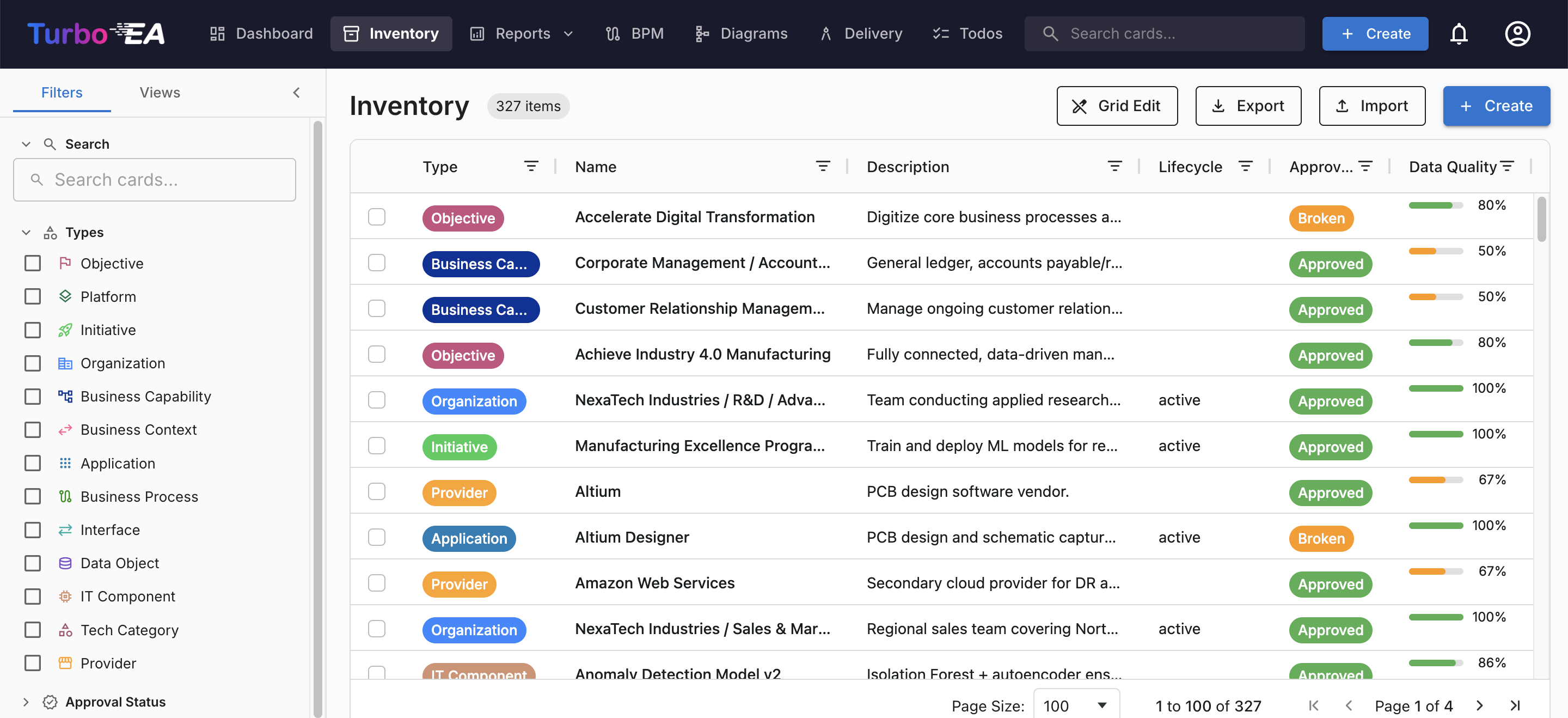
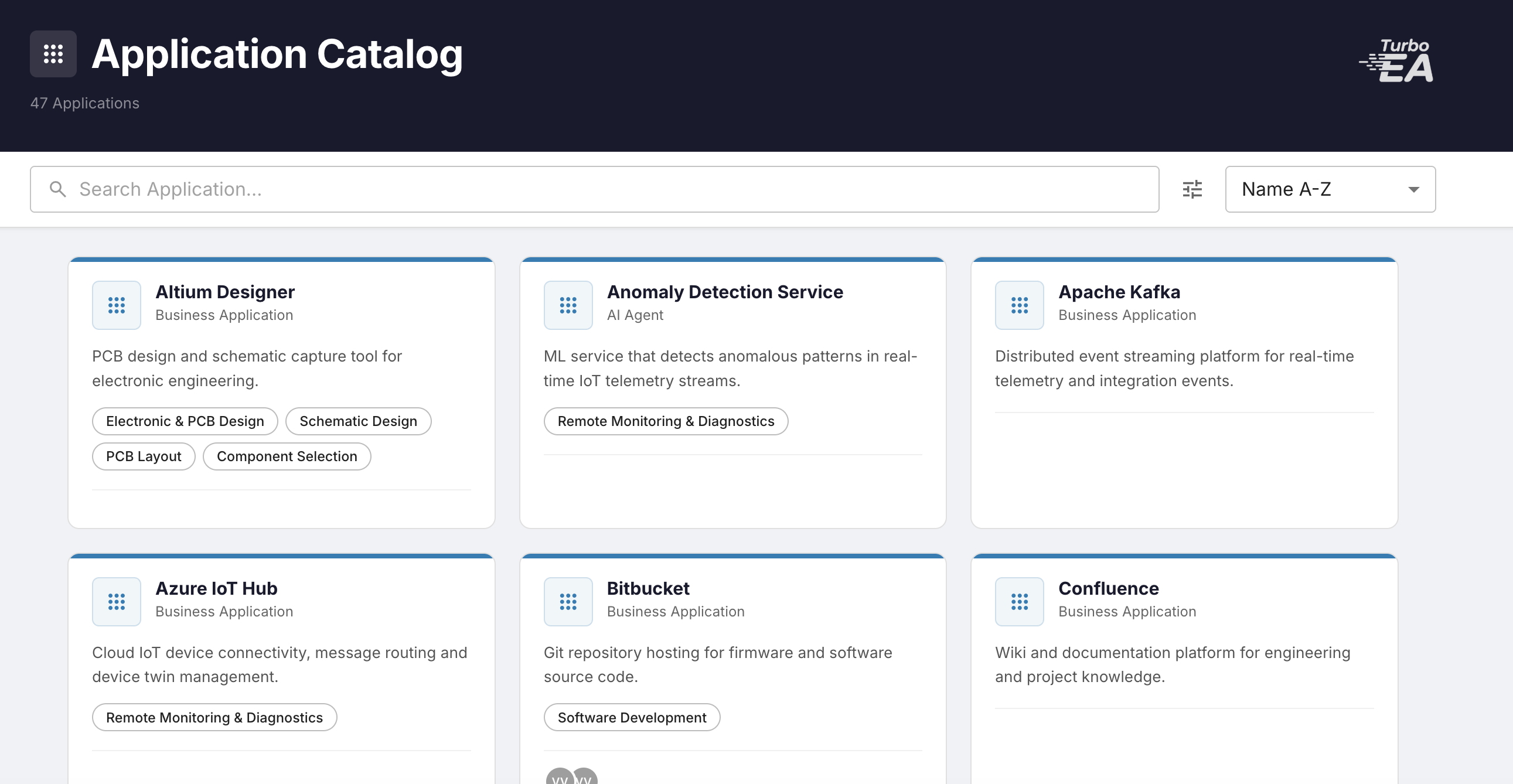
AG Grid-powered data tables with advanced filtering, column customization, Excel import/export, and full-text search.
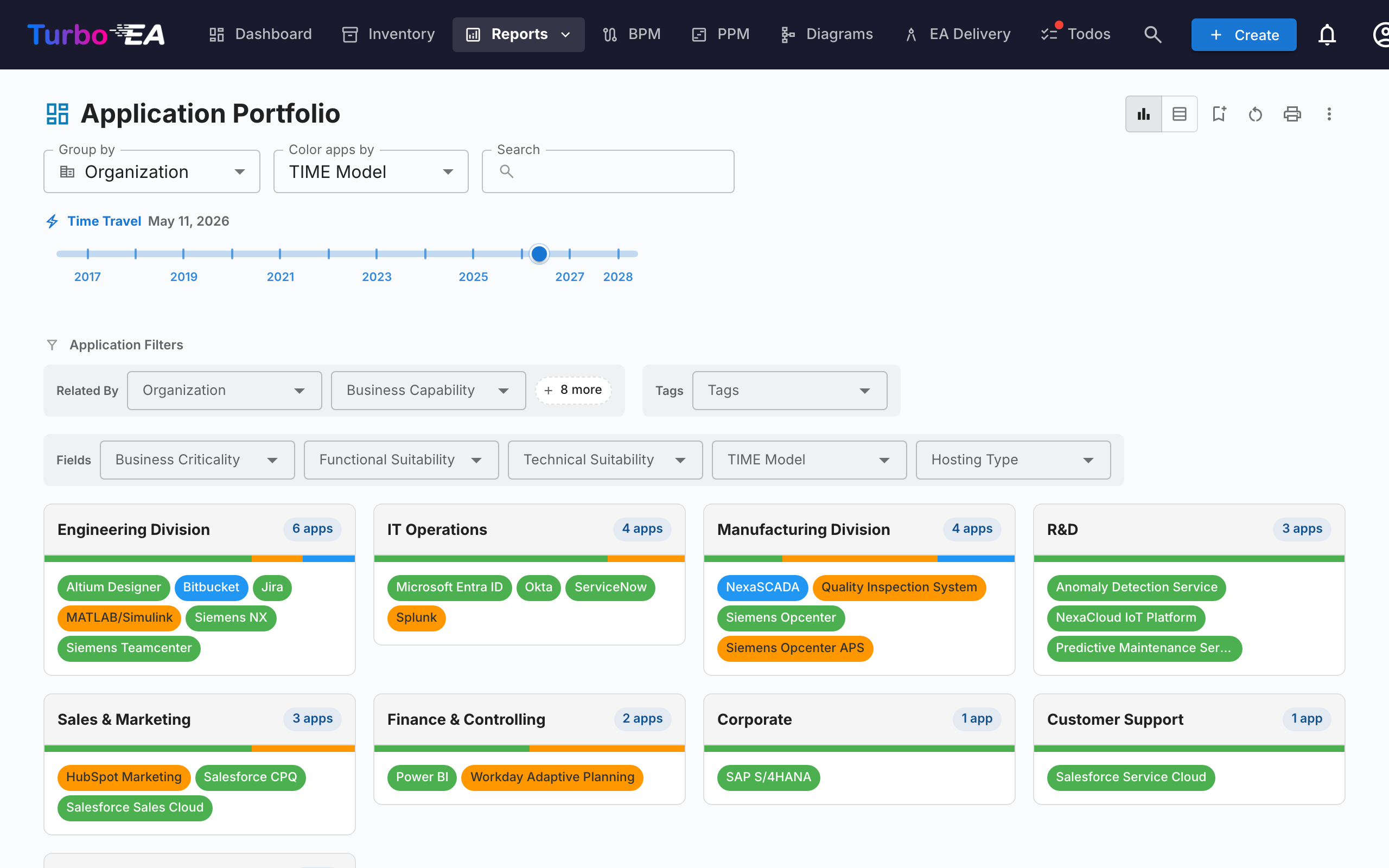
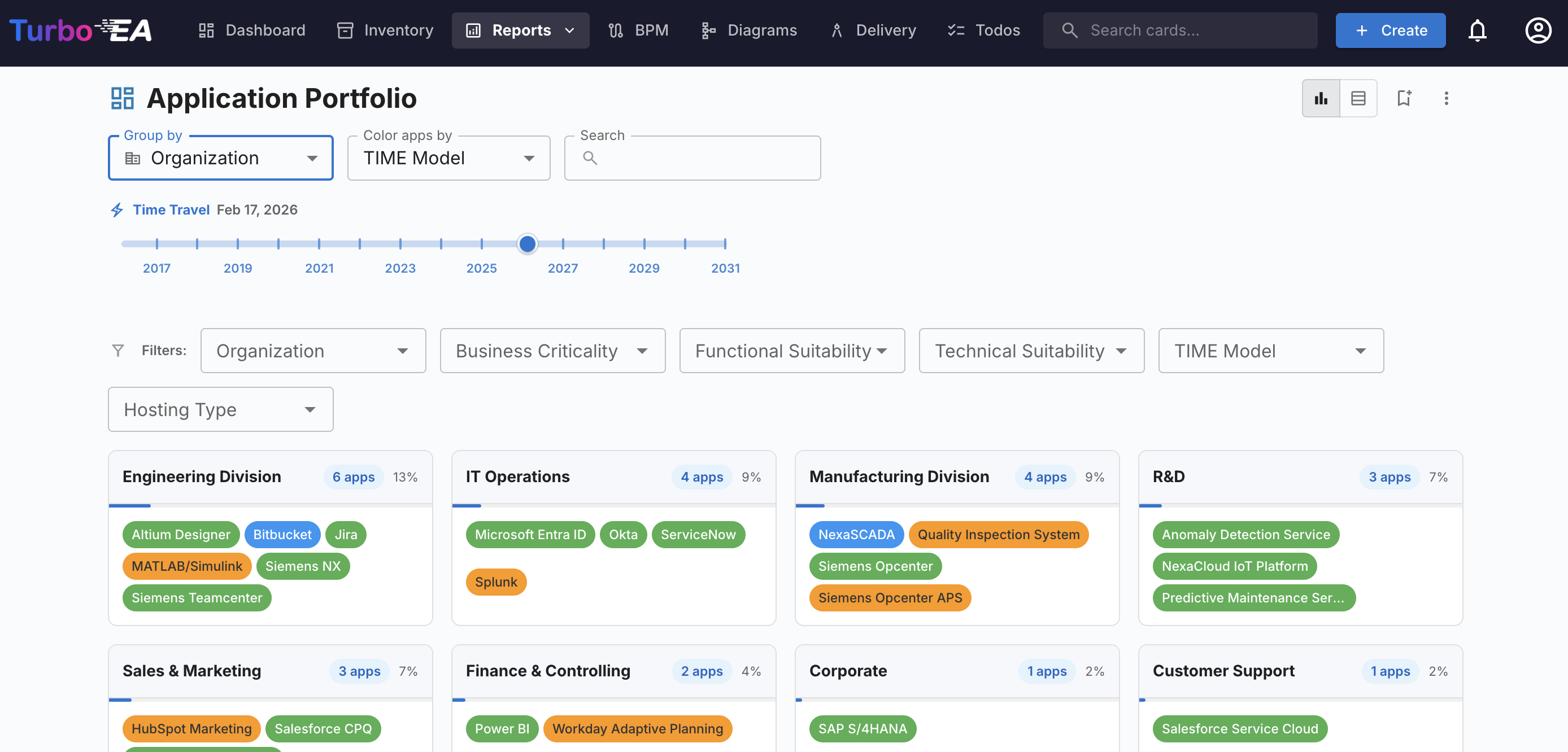
Portfolio bubbles, capability heatmaps, lifecycle roadmaps, dependency graphs, cost treemaps, matrix views, data quality dashboards, and EOL risk reports. Save configurations and share with your team.
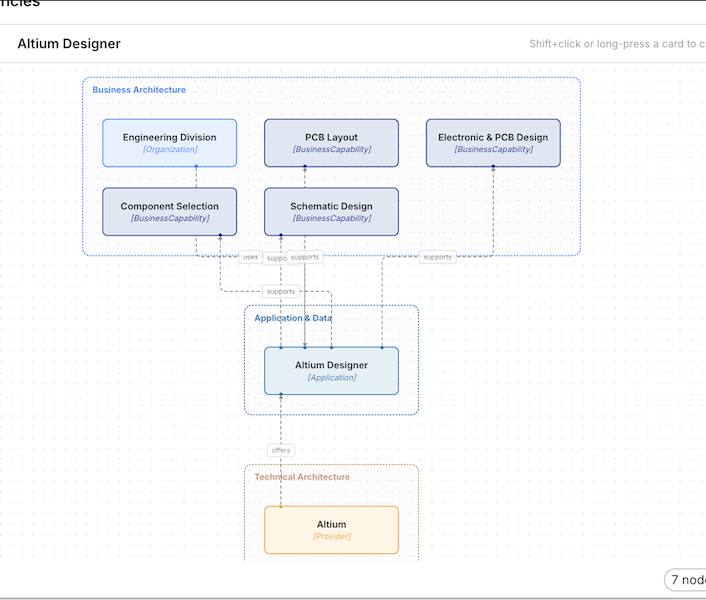
Integrated DrawIO editor with card-aware shapes. Drag applications, interfaces, and systems into architecture diagrams.
Approval workflows (Draft / Approved / Rejected / Broken), auto-computed data quality scoring, data maintenance surveys, calculated fields with formula engine, and hierarchical tags.
Threaded comments, todos with assignments, real-time SSE updates, in-app and email notifications, stakeholder roles, and custom RBAC with 50+ granular permissions.
Statement of Architecture Work editor with rich text sections, version history, sign-off workflows, and DOCX export.
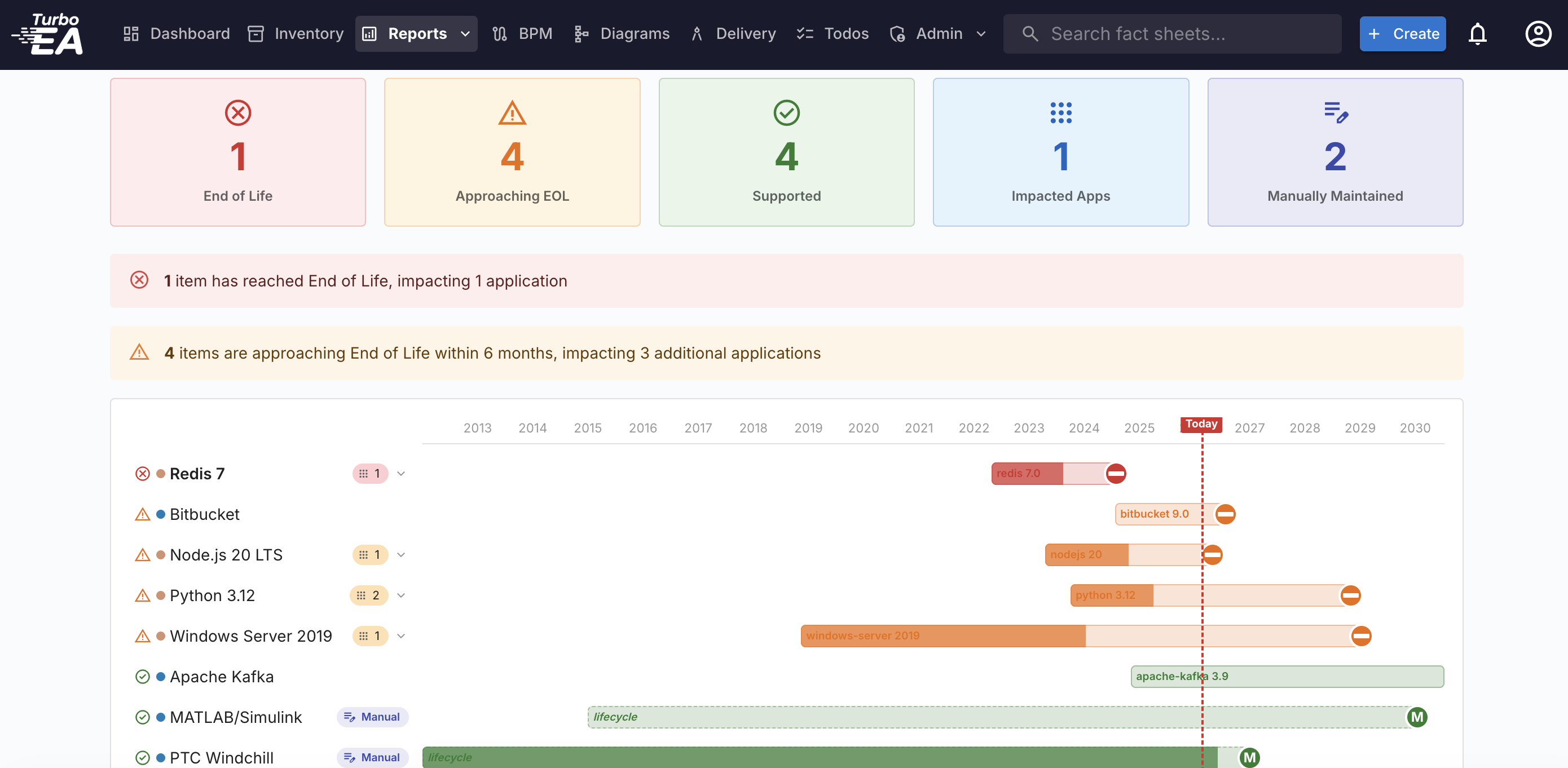
Automatic matching against 300+ products from endoflife.date. Mass search, bulk linking, and EOL risk visualization.
Publish curated, public-facing views of your architecture. Configurable cards, filters, and slug-based URLs — no login required.
View any report as it appeared at a historical date. Timeline slider with year-level granularity to track how your architecture evolved over time.
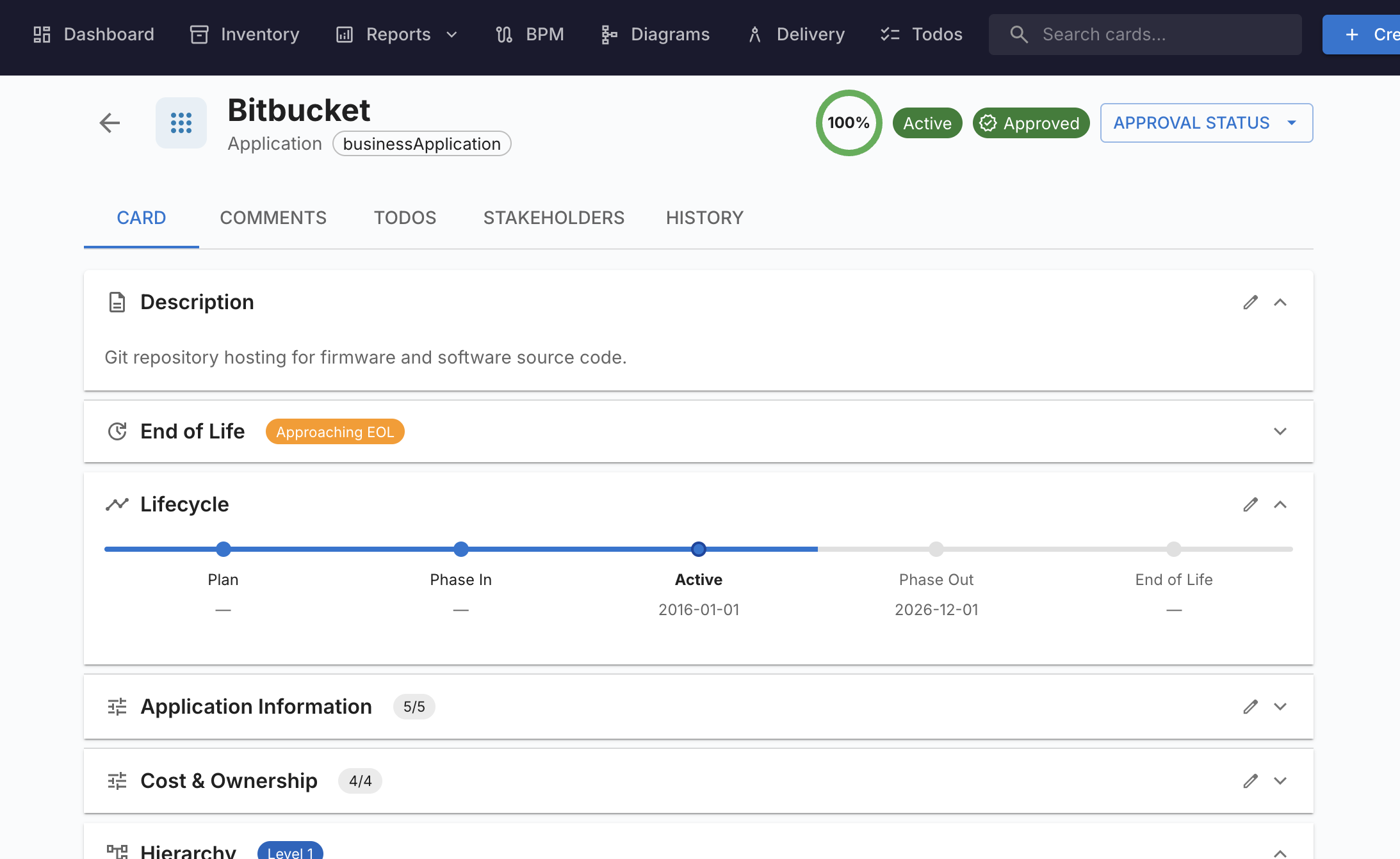
Drag-and-drop visual editor for customizing card detail pages. Section ordering, field grouping, two-column support, and collapsible sections.
Admin-configurable formula engine for computed fields. IF, SUM, AVG, MIN, MAX, COUNT, ROUND, COALESCE with syntax-highlighted editor and autocomplete.
Embedded AI that analyzes your cards and suggests descriptions. Accelerate data entry and improve consistency across your repository.
Built-in Model Context Protocol server that connects Turbo EA to any AI agent — Claude, Gemini, Copilot, ChatGPT, and more. Query your architecture through natural language.
Full UI localization in English, French, German, Portuguese, Italian, Spanish, and Chinese. Switch languages per user with complete translations of every label, menu, and message.
Screenshots from the actual product. Inventory tables, card details, diagram editor, and more.
Turbo EA embeds AI directly into your EA workflow — from smart metadata suggestions to a full MCP server that lets your corporate approved AI agent query your architecture.
The embedded AI analyzes your card content and suggests descriptions. Reduce manual data entry and improve consistency across your entire repository.
Built-in Model Context Protocol server exposes your EA repository to any MCP-compatible AI agent. Claude, Gemini, Copilot, ChatGPT — connect them all and query your architecture through natural language.
Generate a complete Target Architecture, Initiative, and Architecture Decision Record from Business Requirements. The AI Architect analyzes your EA Principles and existing landscape to guide you towards a relevant, well-fitted solution.
The only EA platform with a native BPMN 2.0 process modeler. Model, analyze, and connect business processes directly to your enterprise architecture — no third-party tool required.
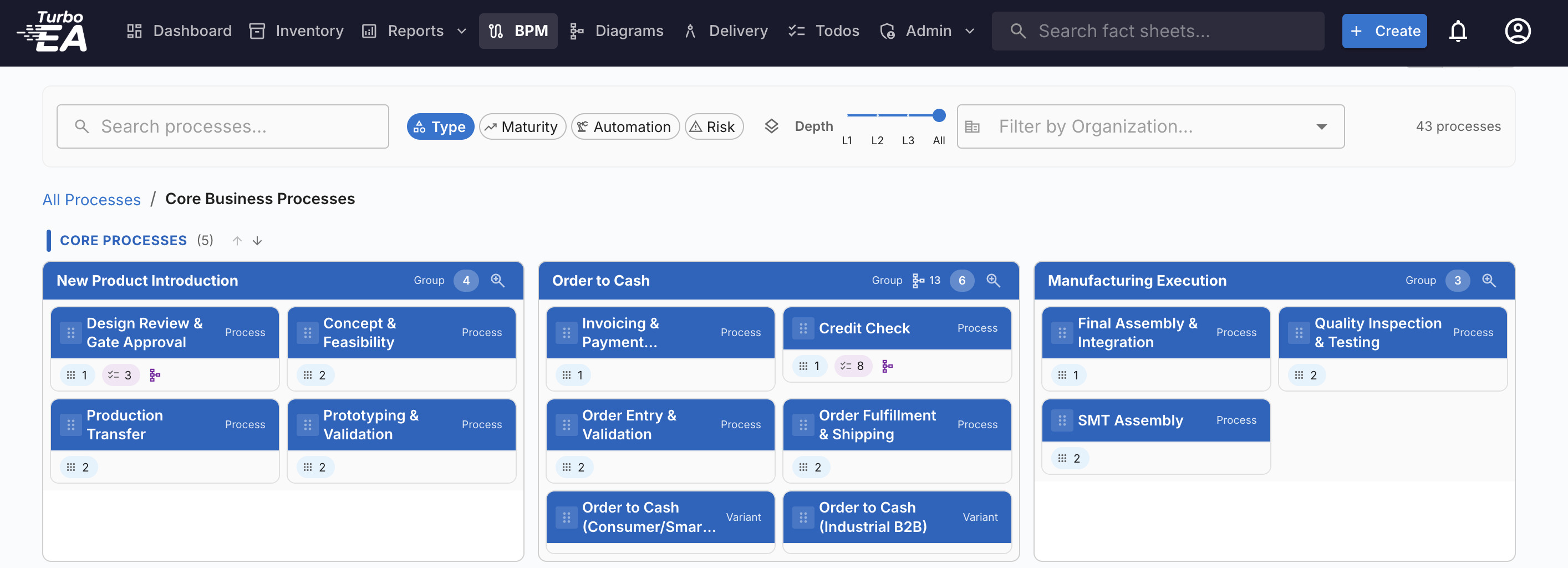
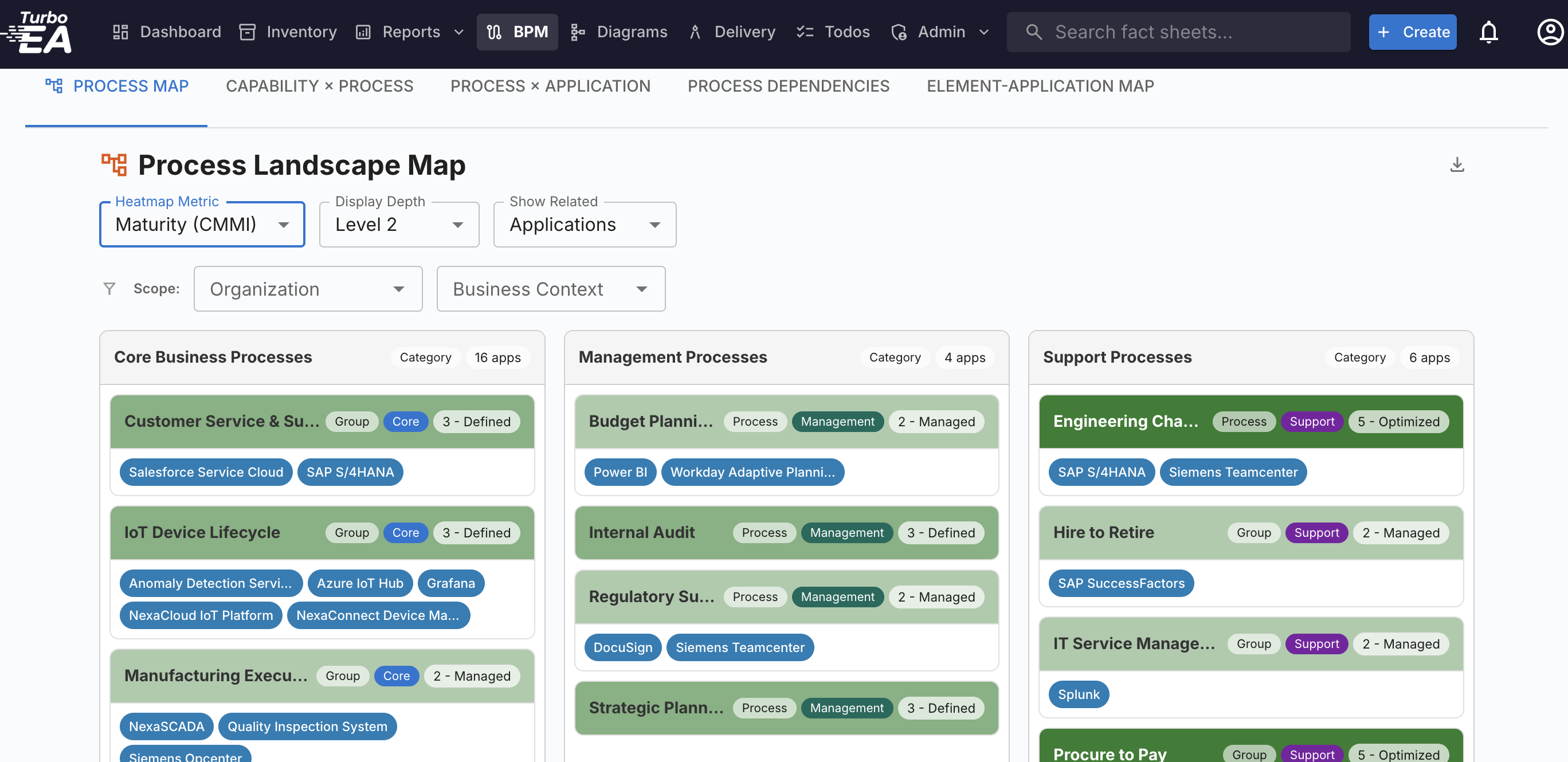
Visual process explorer that maps every business process to its supporting applications, data objects, and IT components. Navigate your process landscape with drill-down from capability to individual BPMN steps.
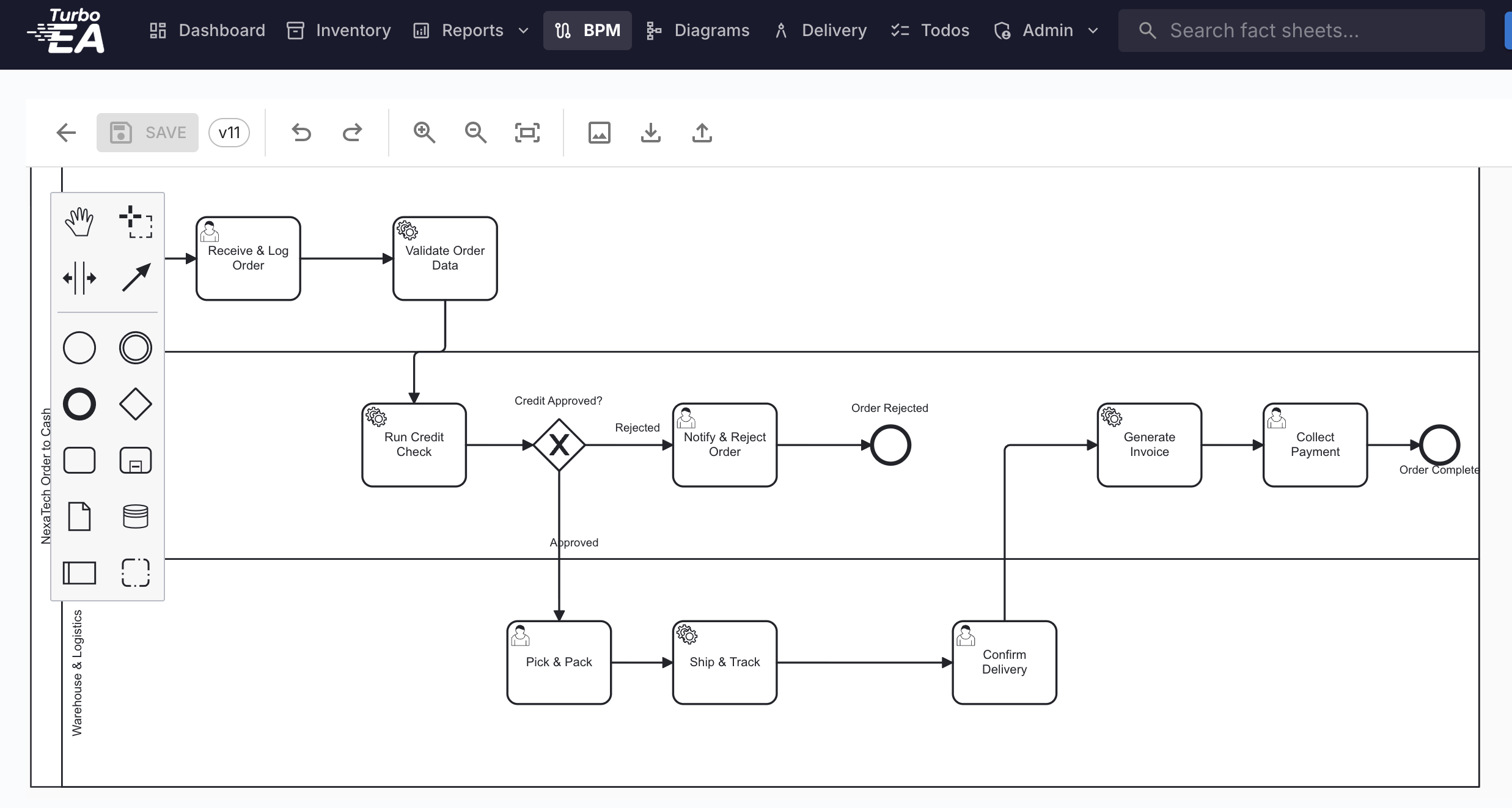
Full-featured process modeling with bpmn-js. Tasks, gateways, events, pools, lanes — all BPMN 2.0 compliant. Draft, published, and archived states with version history and approval workflows.
Link BPMN elements directly to applications, data objects, IT components, and interfaces. See which systems support which process steps in real time.
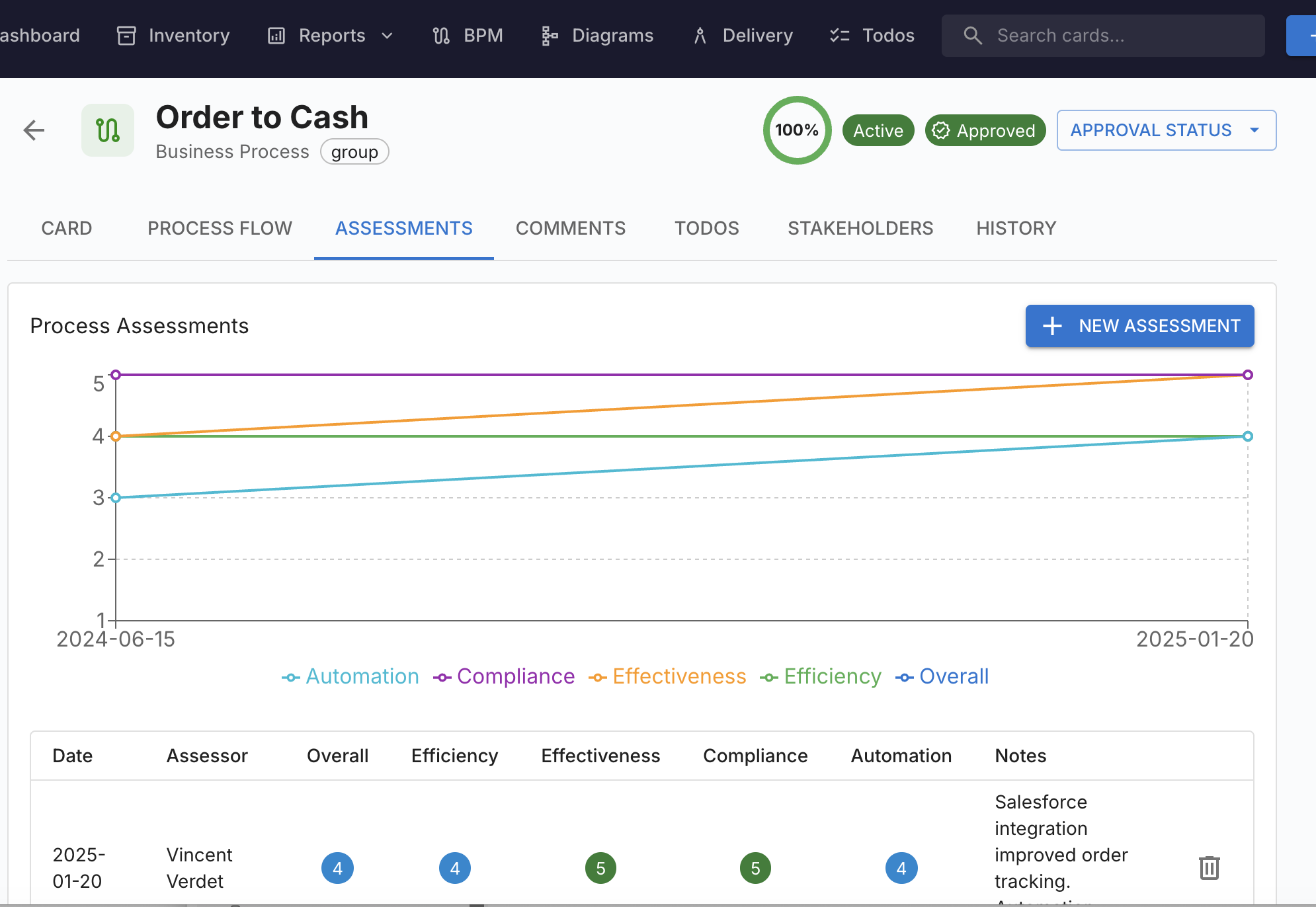
Rate automation level, maturity, complexity, and business criticality of each process. Aggregate scores roll up across the capability hierarchy.
Standard BPMN 2.0 XML interop. Import processes from Camunda, Signavio, or ARIS. Export for execution or compliance documentation.
Start from pre-built templates for common patterns: approval workflows, onboarding, change management, incident response, and more.
Built with proven technologies for performance, reliability, and developer experience.
docker compose up --build -d
Frontend (Nginx) + Backend (uvicorn) in two containers. Bring your own PostgreSQL.
Code continuously scanned and vetted by CodeQL. Dependencies analyzed with Dependabot for vulnerability alerts and automated updates.
Ten interactive report types give you real-time visibility into your architecture landscape.
TIME model bubble chart with configurable X/Y/size/color axes. Plot applications by business criticality, functional fit, technical fit, and cost.
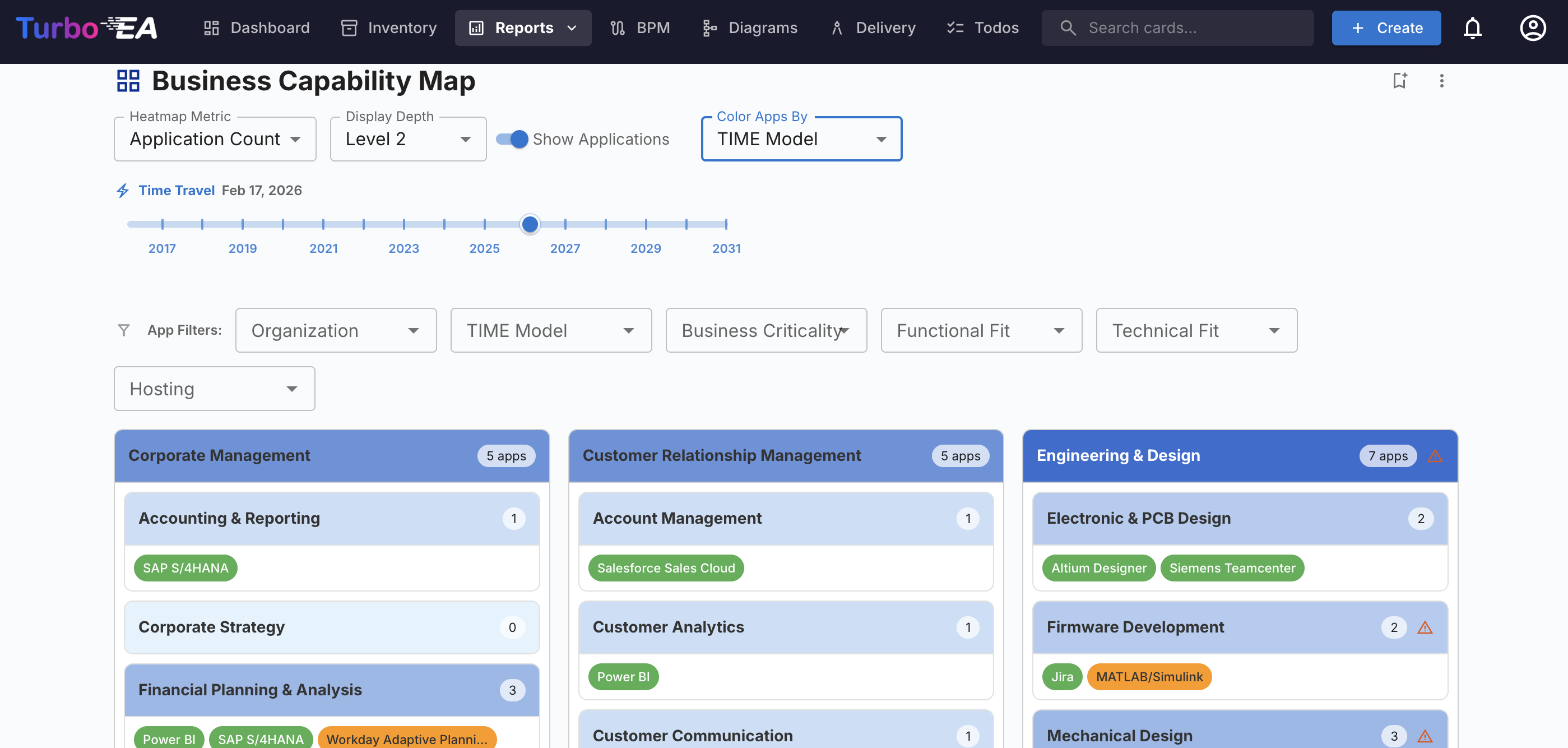
Hierarchical business capability map with color-coded heatmap overlays. See application density, cost concentration, and risk at a glance.
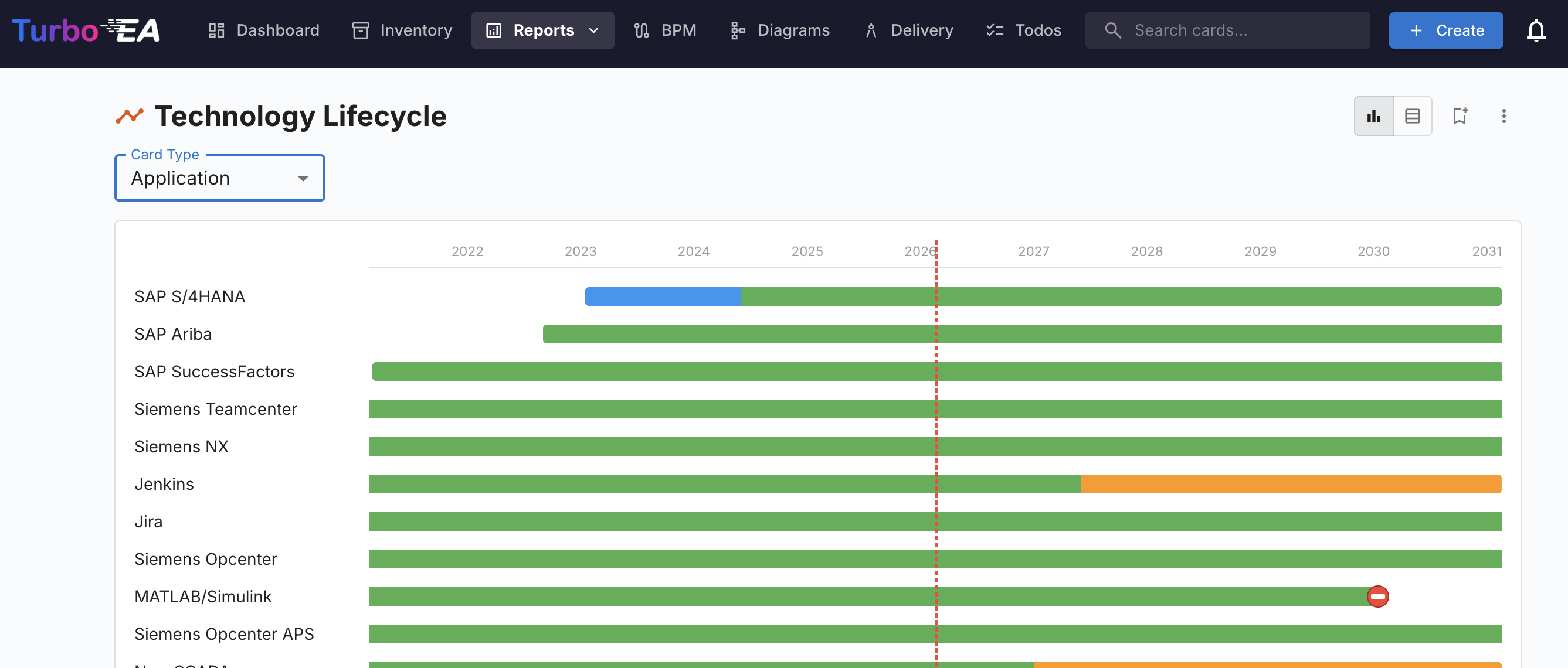
Visualize application lifecycles across time. Track planned, active, phase-out, and end-of-life stages to coordinate transformation.
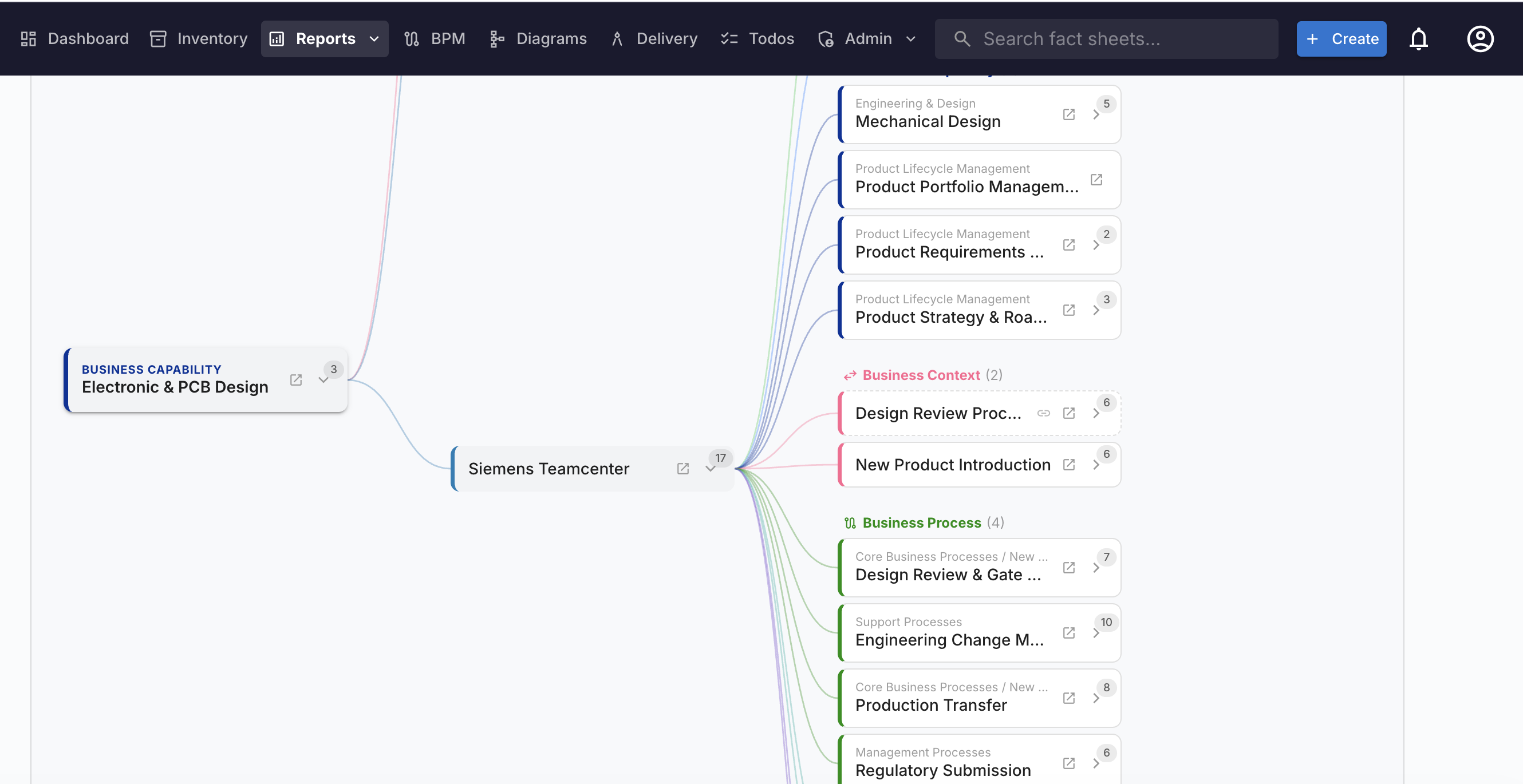
Interactive network visualization of application dependencies with BFS depth limiting. Trace impact paths through your architecture.
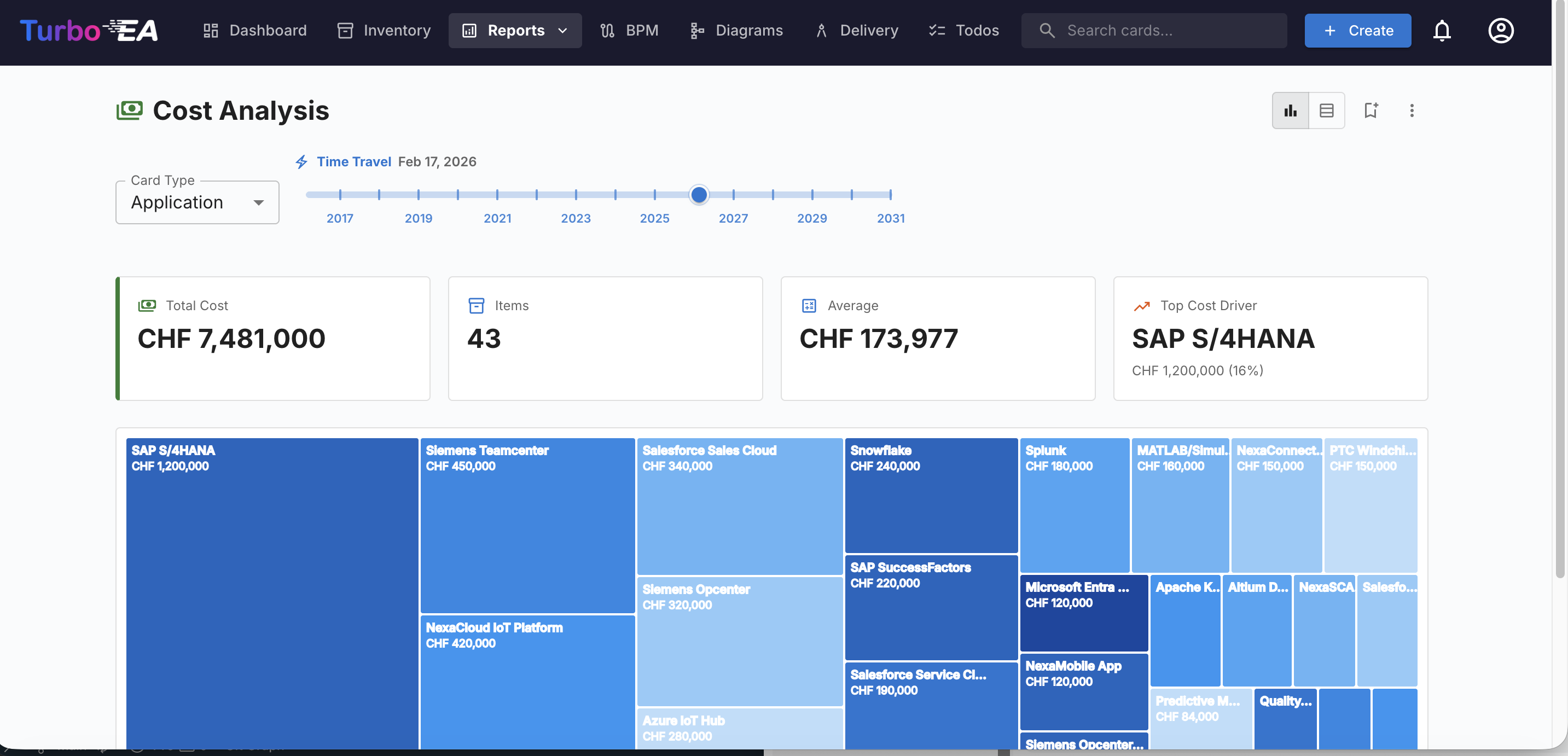
Visualize IT spending as proportional areas. Group by provider, capability, or organization to find optimization opportunities.
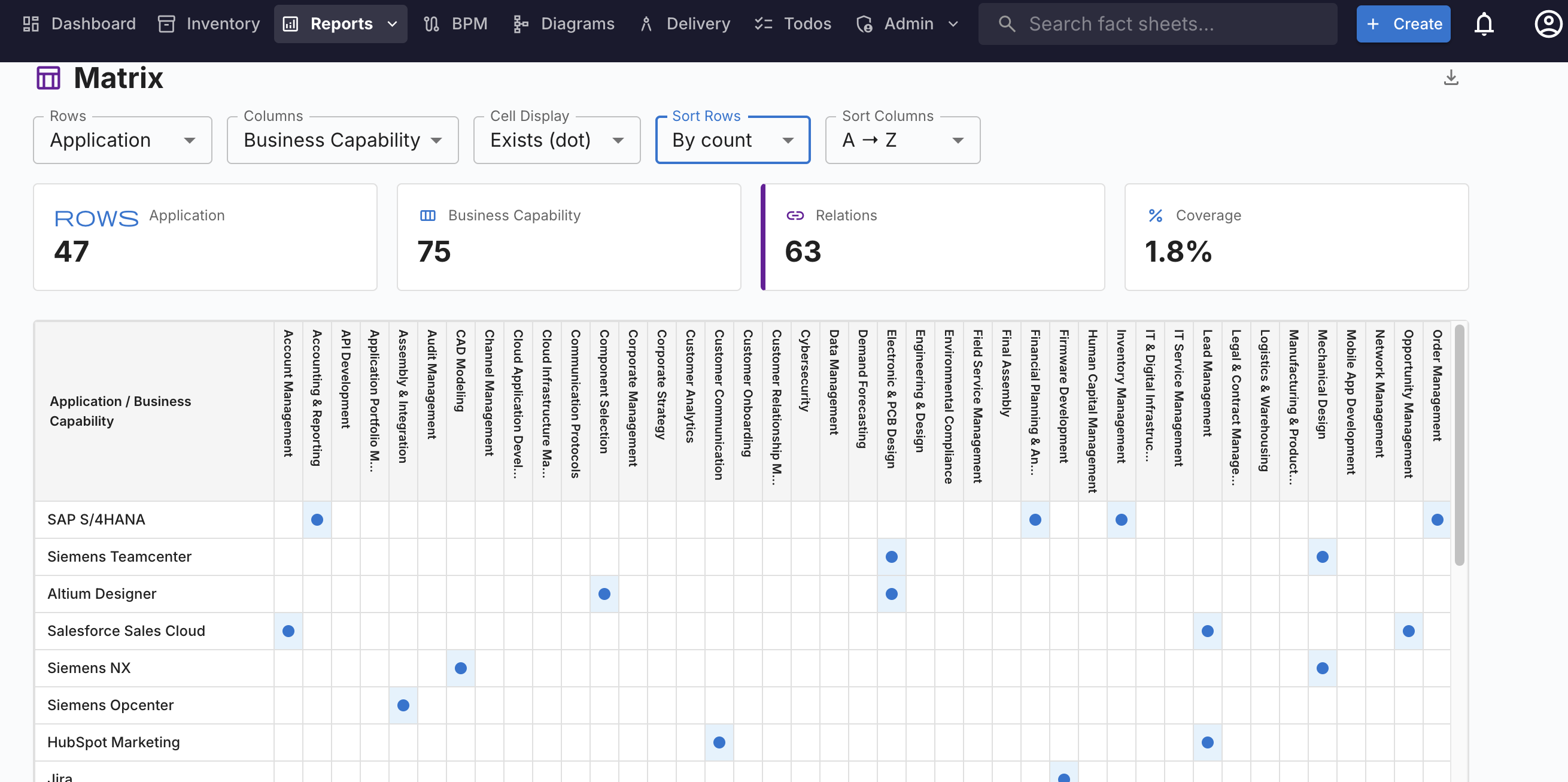
Cross-reference any two card types. Spot coverage gaps, redundancies, and relationships at a glance in an interactive grid.
Track completeness scores by type, find orphaned and stale cards, and identify the worst items needing attention.
Self-hosted DrawIO with custom EA shapes. Cards sync bi-directionally between diagrams and the repository.
Full CRUD API with OpenAPI docs. Integrate with CI/CD pipelines, CMDB sync tools, or build custom dashboards.
Auto-match IT components against 300+ technology products. Track EOL dates, support status, and migration urgency.
Configurable SMTP for notifications, survey invitations, and sign-off requests. No external service dependencies.
Import and export card via Excel or CSV. Bulk-load your existing inventory data in minutes.
Export TOGAF Statements of Architecture Work as formatted Word documents. Ready for stakeholder review and sign-off.
Bidirectional sync with ServiceNow. Field mapping with transform rules, direction control, staged record review, and encrypted credentials.
Generate OData-compatible feeds from saved views and reports. Connect to Excel, Power BI, or any external analytics tool.
SSO callback handling with password setup flow for invited users. Integrate with your corporate identity provider.
Model Context Protocol server lets Claude, Gemini, Copilot, ChatGPT, and any MCP client query your EA repository through natural language.
Unlike SaaS EA tools that lock your architecture data in someone else's cloud, Turbo EA runs entirely in your environment.
Enterprise-grade EA management without the enterprise pricing or vendor lock-in.
Runs on your infrastructure. Your data never leaves your network. Air-gap compatible.
Metamodel is 100% admin-configurable. Types, fields, subtypes, and relations are all data.
No per-seat licensing. Add your entire organization without worrying about subscription costs.
Self-hosted DrawIO with card-aware shapes. Bi-directional sync with the repository.
Statement of Architecture Work editor with rich text, version history, sign-offs, and DOCX export.
Embedded AI suggests descriptions. MCP server enables any corporate approved AI agent to be able to connect to your repository.
Full UI in English, French, German, Portuguese, Italian, Spanish, and Chinese.
Full source code. Extend, customize, and contribute. No vendor lock-in, ever.
Deploy Turbo EA in minutes. The first user gets admin automatically. Add your team, configure your metamodel, and start building your architecture digital twin.
docker compose up --build -d